For Agents
How to Access E&S Carriers as an Independent Agent
Your email has been registered. Redirecting...
Sign up now to access carriers, get leads, and grow your book.
Key Takeaways
- The E&S market writes over $98 billion in annual premium. It's not a niche fallback. It's a core part of the P&C industry.
- Most independent agents don't need a surplus lines license. Partner with a wholesale broker and they handle licensing, compliance, and carrier access for you.
- You have four access paths: wholesale brokers, direct MGA appointments, digital E&S platforms, and agent networks. Most agents use more than one.
- E&S carriers don't participate in state guaranty funds. Always verify AM Best ratings and disclose this to every client before binding.
- E&S access is a retention tool, not just a placement solution. Agents who can say yes when the standard market says no keep more clients and write more premium.
At some point, every independent agent hits the same wall.
A client walks in with a risk that’s either too complex, too niche, or too exposed for the standard admitted market. You run the submissions, and the declinations come back one after another. The standard market has no appetite. The client needs coverage. And you’re left wondering where to turn.
That’s the moment the Excess and Surplus lines market was built for.
E&S carriers exist to cover what admitted carriers won’t touch, and for independent agents willing to learn how to access them, the opportunity on the other side is significant. This guide covers everything you need to know: what E&S actually is, why it matters more than ever right now, and the practical steps to start placing business in this market.
What Is the E&S Market, and Why Does It Exist?
The U.S. insurance market operates in two lanes. The admitted market consists of carriers licensed and regulated by each state’s Department of Insurance. These carriers follow strict rate and form filings, participate in state guaranty funds, and operate within standardized underwriting guidelines. They’re built for predictable, well-defined risks.
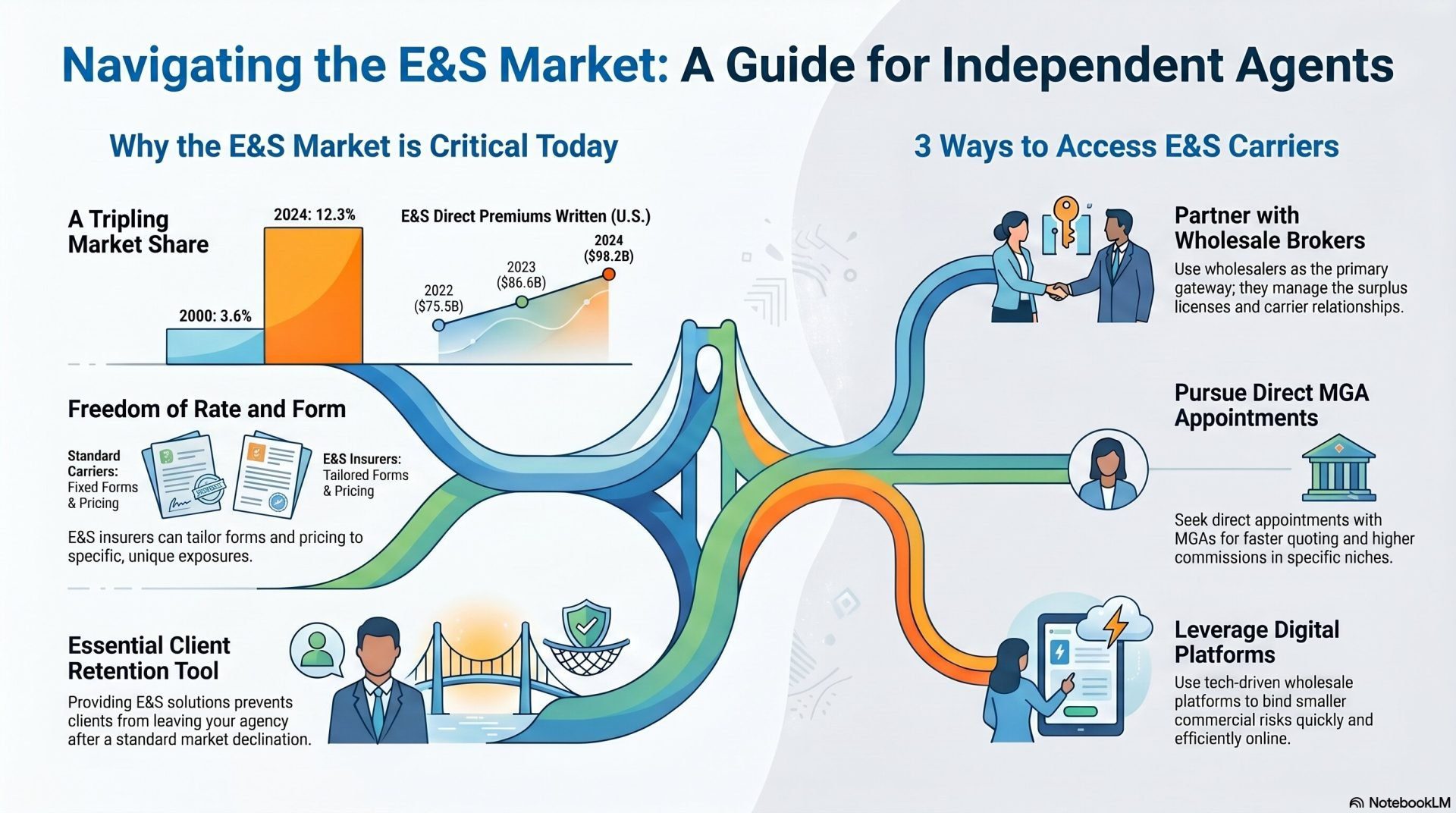
The E&S market operates differently. E&S carriers, also called non-admitted or surplus lines insurers, are not licensed in the states where they write business. That sounds alarming until you understand what it means in practice. Because they’re not subject to the same rate and form regulations, E&S carriers have the flexibility to underwrite risks that don’t fit standard templates, price them accordingly, and write coverage on manuscript forms tailored to the specific exposure.
This flexibility is the entire point. A cannabis dispensary, a vacant commercial building, a contractor with multiple prior claims, a coastal property facing hurricane exposure, a startup in an industry that didn’t exist five years ago: none of these fit neatly into admitted underwriting boxes. E&S carriers take on what standard markets decline, and they do it profitably because their pricing and terms reflect the actual risk.
The scale of this market is no longer niche. U.S. E&S direct premiums written reached $98.2 billion in 2024, up from $86.6 billion in 2023 and $75.5 billion in 2022. Surplus lines insurers’ share of the total P&C market has more than tripled since the start of the century, rising to 12.3% at the end of 2024 from just 3.6% in 2000. For independent agents, that’s not a niche market worth occasionally exploring. That’s a material segment of the industry.
Why Independent Agents Need E&S Access Right Now
The standard market is tightening in ways that directly affect your book.
Admitted carriers are pulling back from catastrophe-exposed geographies, tightening commercial underwriting guidelines, and non-renewing risks they would have happily written five years ago. Climate-driven losses, social inflation, nuclear jury verdicts, and rising reinsurance costs are all pushing carriers to shrink their appetite. That business has to go somewhere.
Clients get dropped by standard carriers for many reasons: a water loss, a DUI, poor credit, or a missed premium payment. Without a non-standard option, those clients are forced to leave your agency. With access to E&S markets, you can keep them on the books and guide them toward future eligibility for preferred coverage.
That last point is worth pausing on. E&S access isn’t just a problem-solver for hard-to-place risks. It’s a client retention tool. An agent who can say “I found you a solution” is far more valuable than one who says “I can’t help you here.” And with E&S policies typically presenting a chance to earn higher premiums and therefore higher revenue from fewer transactions, the economics of placing E&S business also work in your favor.
The agents building durable, diversified books right now are the ones who have figured out how to operate in both lanes.
Join the Agency Height Newsletter.
Stay ahead with industry trends, acquisition opportunities, and growth insights for ambitious insurance professionals.
Agency Height Markets: The Bridge While your E&S Practice Matures
Wholesaler relationships, niche expertise, and disciplined submissions compound over time — and while that traditional path is true and proven, it can take months, sometimes years, before it’s fully in place.
In the meantime, the hard-to-place risks landing in your inbox still need an answer.
Agency Height Markets is built to cover that in-between. It lets independent agents write business through our wholesale underwriter from the start, with access to specialty and E&S carriers and no volume minimum — or request direct appointments from the same dashboard when you’re ready. Use it to keep placing the risks the standard market won’t write today, while the relationships above continue to compound underneath.
The long game still wins. Markets just makes sure you’re still in the game when it pays off.
The Key Players in the E&S Distribution Chain
Before you can access E&S carriers, you need to understand how the market is structured. It doesn’t work the way admitted carrier distribution does.
Wholesale Brokers (Surplus Lines Brokers)
Wholesale brokers are the primary gateway between retail independent agents and E&S carriers. They hold the surplus lines licenses, maintain direct carrier relationships, and know which markets have appetite for which classes of business. When you have a risk you can’t place in the standard market, you submit it to a wholesale broker, who shops it to their E&S carrier relationships and brings back a quote.
E&S wholesalers provide access to specialty markets that insure risks standard carriers won’t cover. These specialists, known as general agents or wholesalers, are the link between the insured, the retail insurance broker, and the E&S carrier.
The quality and depth of a wholesale broker’s carrier relationships determine how many options you get back and how competitive the terms are. Building relationships with multiple wholesalers gives you broader market access and more leverage when shopping complex risks.
Managing General Agents (MGAs) and Managing General Underwriters (MGUs)
MGAs are specialty intermediaries that have been delegated underwriting authority by a carrier. They operate like mini-insurers within a specific niche, class of business, or geographic market. An MGA writing coastal habitational property, for example, has deep expertise in that class and can bind coverage more quickly than a traditional wholesale submission.
MGUs go a step further: they hold binding authority and can issue policies directly. For independent agents, getting appointed with the right MGAs and MGUs can dramatically speed up your ability to quote and bind E&S business without routing every submission through a wholesale broker.
Program Administrators
Program administrators are similar to MGAs but operate around a defined group of similar risks. Think contractors in a specific trade, a hospitality program, or a transportation niche. If a significant portion of your book falls into a definable class, finding the right program administrator can give you access to preferential rates, streamlined underwriting, and binding authority within that class.
How Independent Agents Actually Access E&S Carriers
There are four practical paths to E&S market access, and most active independent agents use a combination of them.
- Partner with Wholesale Brokers
The most common and most straightforward path is building working relationships with established wholesale brokers. Firms like Burns & Wilcox, AmWINS, Ryan Specialty, and CRC Group operate at scale with relationships across hundreds of E&S carriers. Smaller regional wholesalers often have deep expertise in specific classes or geographies that national firms don’t replicate.
The key is not just finding a wholesale broker, but finding the right ones for the classes of business you write. A wholesaler with strong appetite in coastal property may have thin connections in professional liability. Build relationships across multiple shops, learn their specialties, and route submissions accordingly.
Start by building relationships with trusted wholesale brokers who understand your business. When a client walks through your door with a hard-to-place risk, a vacant property, a contractor with claims history, or a startup in an emerging industry, E&S placement can keep the relationship in-house.
- Pursue Direct MGA Appointments
If you write volume in a specific class, seek direct appointments with MGAs that specialize in that space. Direct appointments often come with better commission structures, faster quoting turnaround, and direct access to underwriters who can work through complex submissions with you.
Getting appointed takes time and volume commitments, but for agents building a niche, the investment pays off. Platforms like MyNewMarkets.com make it easier to find and connect with MGAs across specific classes and states.
- Use Digital E&S Platforms
Technology has changed E&S access materially over the past several years. Digital wholesale platforms now allow retail agents to submit risks, receive quotes from multiple E&S carriers simultaneously, and bind coverage online, in some cases within minutes.
Platforms are transforming the economics of small-commercial insurance, enabling brokers and agents to handle significantly more accounts with higher margins. For smaller commercial risks and personal lines E&S placements, these platforms reduce friction and cut submission time. For more complex or high-value risks, a traditional wholesale broker relationship still adds more value.
- Join an Independent Agent Network or Alliance
Many independent agent networks and alliances negotiate group access to E&S markets for their members. Network membership can give a smaller agency access to wholesale relationships and market appointments that would take years to build independently. If you’re not already affiliated with a network, E&S market access is a legitimate reason to evaluate membership.
Licensing: What You Actually Need
Independent agents often assume they need a separate surplus lines license to place E&S business. In most cases, that’s not accurate.
As a retail agent, you need a standard property and casualty license in your state. You submit the risk to a licensed surplus lines broker or wholesale broker, who holds the surplus lines license and manages the carrier relationship. The compliance obligations fall on the wholesale broker, not on you.
That said, if you plan to act as both the retail agent and the surplus lines broker, or if you want to place E&S business directly without routing through a wholesaler, you’ll need a surplus lines license in your state. Requirements vary by state but generally include holding an active P&C license for a defined period, passing an additional surplus lines exam, and sometimes meeting a minimum production threshold.
For most independent agents starting out in E&S, partnering with a wholesale broker is the simpler and faster path. You focus on the relationship and risk submission. The wholesaler handles the licensing, compliance, carrier access, and tax filings.
Compliance: What You Need to Know Even as a Retail Agent
Even if the compliance burden sits primarily with the wholesale broker, you need to understand the framework. Compliance issues in E&S transactions can affect your client, your E&O exposure, and your relationship with the wholesaler.
The Diligent Search Requirement
Most states require that before a risk is placed in the E&S market, a reasonable effort be made to place it in the admitted market first. This is called the diligent search or diligent effort requirement. Many states expressly require that at least three declinations be obtained from licensed admitted insurers as a reasonable proxy for demonstrating that coverage is not readily available in the standard market.
The exact requirements vary by state. Some states have “export lists” of risk classes where the diligent search is not required because admitted market unavailability is already established. Most states do not direct surplus lines brokers as to how the declination must be obtained, but some states require written documentation of declinations.
As a retail agent, your role is to document your own efforts to find admitted market coverage before escalating to E&S. Keep records of which admitted carriers you approached, when, and what the outcome was. That documentation protects you and supports your wholesaler’s compliance requirements.
Surplus Lines Taxes
Each surplus lines transaction is subject to a premium tax, with rates varying by state, typically ranging from 2% to over 6%. These taxes must be calculated and remitted to the appropriate authority. The wholesale broker handles this, but as the retail agent, you need to make sure your client understands that the premium on an E&S policy includes these taxes and fees, which is why E&S premiums are sometimes higher than equivalent admitted market pricing.
No Guaranty Fund Protection
This is the most important disclosure you need to make to every client you place in the E&S market. Unlike admitted carriers, E&S insurers don’t participate in state guaranty funds. If an E&S carrier becomes insolvent, policyholders would become general creditors in insolvency proceedings. This makes carrier financial strength ratings critical. Always check AM Best ratings before placing business with an E&S carrier, and communicate the distinction to your client clearly.
The Risk Classes Driving E&S Demand Right Now
Understanding where E&S appetite is strongest helps you identify which parts of your existing book have E&S potential and where to prospect.
Catastrophe-Exposed Property. Coastal homeowners, wildfire-zone properties, and flood-exposed commercial real estate are all driving E&S growth. E&S homeowners premiums grew 45.2% in 2024, rising to $3.2 billion, fueled by an 86% increase in California’s domestic E&S homeowners premiums. As admitted carriers continue to exit these markets, E&S will absorb more of this volume.
Commercial General Liability. CGL remains the largest single E&S line. Contractors with prior claims, businesses in high-litigation industries, and operations with unusual liability exposures are all natural E&S placements.
Commercial Auto. Commercial auto fueled 29.1% year-over-year growth in E&S premium through mid-2025. Fleets with poor loss histories, specialty vehicles, and transportation risks that admitted carriers have abandoned are increasingly landing in E&S.
Cyber Liability. Businesses with weaker security postures or in high-target industries often can’t find adequate cyber coverage in the admitted market. E&S carriers have stepped into this gap with more flexible underwriting.
Emerging and Niche Industries. Cannabis operations, short-term rentals, gig economy businesses, and renewable energy projects all represent classes where the admitted market either doesn’t have forms or doesn’t have appetite. E&S is often the only option.
Building Your E&S Practice: A Practical Framework
Accessing E&S carriers is one thing. Building a sustainable E&S practice inside your agency is another.
Start by auditing your current book for E&S candidates. Clients who’ve had prior losses, operate in hard-to-place classes, or are in catastrophe-exposed areas may already be underserved. Those are your first E&S conversations.
Identify two or three wholesale brokers who align with your primary classes of business and make introductions. Be honest about your current E&S volume and your goals. Good wholesale brokers want to grow with retail agents who are serious about the market.
Learn the language. E&S submissions require more detail than standard market applications. Underwriters need to understand the risk fully because they’re pricing from scratch rather than following filed rates. The more thorough your submissions, the better your quotes and the faster your turnaround.
Set client expectations clearly. E&S policies can be non-standard in form, have different cancellation provisions, and don’t carry guaranty fund protection. Clients deserve to understand what they’re buying before they bind.
Finally, document everything. Compliance in the E&S market is more detailed than in the admitted market. The agents who build this practice successfully treat compliance as part of their workflow from day one, not as an afterthought.
The Bottom Line
The E&S market is no longer a fallback for hard-to-place outliers. It’s a material, growing segment of the P&C industry, and the agents who understand how to access it are building more resilient, more diversified books.
You don’t need a surplus lines license to start. You need a willingness to learn the market, a wholesale broker relationship or two, and the discipline to document your submissions and disclose properly to clients.
The risks that standard carriers won’t touch still need coverage. The independent agents who can find that coverage will keep more clients, write more premium, and build the kind of reputation that generates referrals on its own.
Start building those wholesale relationships today.
Agency Height provides independent agents with the tools, market intelligence, and resources to build stronger books of business. Explore our agent resources or connect with wholesale market partners through the Agency Height platform.
Frequently Asked Questions
-
Do I need a special license to place E&S business?
No, in most cases. As a retail agent, you submit through a licensed wholesale broker who handles the surplus lines license, compliance, and tax filings. You only need your own surplus lines license if you want to place business directly without a wholesaler.
-
What risks typically go to the E&S market?
Any risk the admitted market declines. Common examples: contractors with prior claims, coastal or wildfire-exposed properties, cannabis businesses, cyber risks, vacant buildings, and startups in industries without standard market forms.
-
What is the diligent search requirement?
Before placing a risk in the E&S market, most states require you to show the admitted market declined it first, usually with three written declinations. Requirements vary by state. Document every admitted market attempt. It protects you and your wholesaler.
-
Is E&S coverage more expensive?
It can be. E&S carriers price each risk individually rather than using filed rates, and surplus lines taxes of 2% to 6% apply on top of premium. For non-standard risks, E&S is often the only option available, so comparing cost to the admitted market is rarely the right frame.
-
How do I find the right wholesale broker?
Match the broker to the class of business you write. Larger nationals like Burns & Wilcox, AmWINS, and Ryan Specialty cover broad lines. Regional wholesalers often go deeper in specific niches or states. Start with two or three relationships, learn their appetites, and route submissions accordingly.
Free Carrier Access. $0 to Start.
Carrier Said No? There's Still a Market.
Table of Contents
- What Is the E&S Market, and Why Does It Exist?
- Why Independent Agents Need E&S Access Right Now
- Agency Height Markets: The Bridge While your E&S Practice Matures
- The Key Players in the E&S Distribution Chain
- How Independent Agents Actually Access E&S Carriers
- Licensing: What You Actually Need
- Compliance: What You Need to Know Even as a Retail Agent
- The Risk Classes Driving E&S Demand Right Now
- Building Your E&S Practice: A Practical Framework
- The Bottom Line
- Frequently Asked Questions
- What Is the E&S Market, and Why Does It Exist?
- Why Independent Agents Need E&S Access Right Now
- Agency Height Markets: The Bridge While your E&S Practice Matures
- The Key Players in the E&S Distribution Chain
- How Independent Agents Actually Access E&S Carriers
- Licensing: What You Actually Need
- Compliance: What You Need to Know Even as a Retail Agent
- The Risk Classes Driving E&S Demand Right Now
- Building Your E&S Practice: A Practical Framework
- The Bottom Line
- Frequently Asked Questions
More Markets. More Leads. One Platform.
Sign up now for carrier access, get found online, and write more business.
Your email has been registered. Redirecting...