For Agents
How to Get Appointed with a Wholesale Carrier: A Complete Guide
Your email has been registered. Redirecting...
Sign up now to access carriers, get leads, and grow your book.
Key Takeaways
- A wholesale appointment is a formal agreement that authorizes you to submit E&S business through a wholesale broker or MGA. It's your gateway to non-admitted markets.
- Wholesalers evaluate your license, E&O coverage, book focus, and production volume. Showing up prepared matters more than showing up big.
- Make contact before you apply. A warm application to a wholesaler who already knows your name moves faster than a cold form submission.
- Once appointed, read the commission agreement carefully. Know what the wholesaler keeps, what fees apply, and who owns the book if the relationship ends.
- Build three to five focused wholesale relationships across complementary specialties. Breadth without focus wastes everyone's time.
Most independent agents understand the E&S market in theory. They know surplus lines carriers cover the risks the admitted market won’t touch, and they know wholesale brokers are the gateway to those carriers. What fewer agents know is what it actually takes to get appointed with a wholesale broker, what the process looks like, and what wholesalers are genuinely evaluating when they decide whether to work with you.
That’s what this guide covers.
If you haven’t read the earlier pieces in this series, here’s the short version: E&S carriers are non-admitted insurers that write risks the standard market declines. Retail independent agents access them primarily through wholesale brokers, who hold surplus lines licenses and maintain direct carrier relationships. Getting appointed with a wholesaler is the foundational step that unlocks that access. Everything else builds from there.
What a Wholesale Appointment Actually Is
A wholesale appointment is a formal working agreement between a retail independent agent and a wholesale broker or MGA. It authorizes you to submit business to them, establishes how commissions are split, and outlines the terms of the relationship.
Unlike a direct carrier appointment in the admitted market, a wholesale appointment doesn’t give you direct access to the carrier. The wholesale broker sits between you and the E&S carrier. You bring the risk. They shop it to their carrier relationships, negotiate terms, and return a quote. You present it to your client, bind the coverage, and the wholesaler handles the surplus lines compliance and tax filings on the back end.
There are also three meaningfully different types of appointments worth understanding before you start the process:
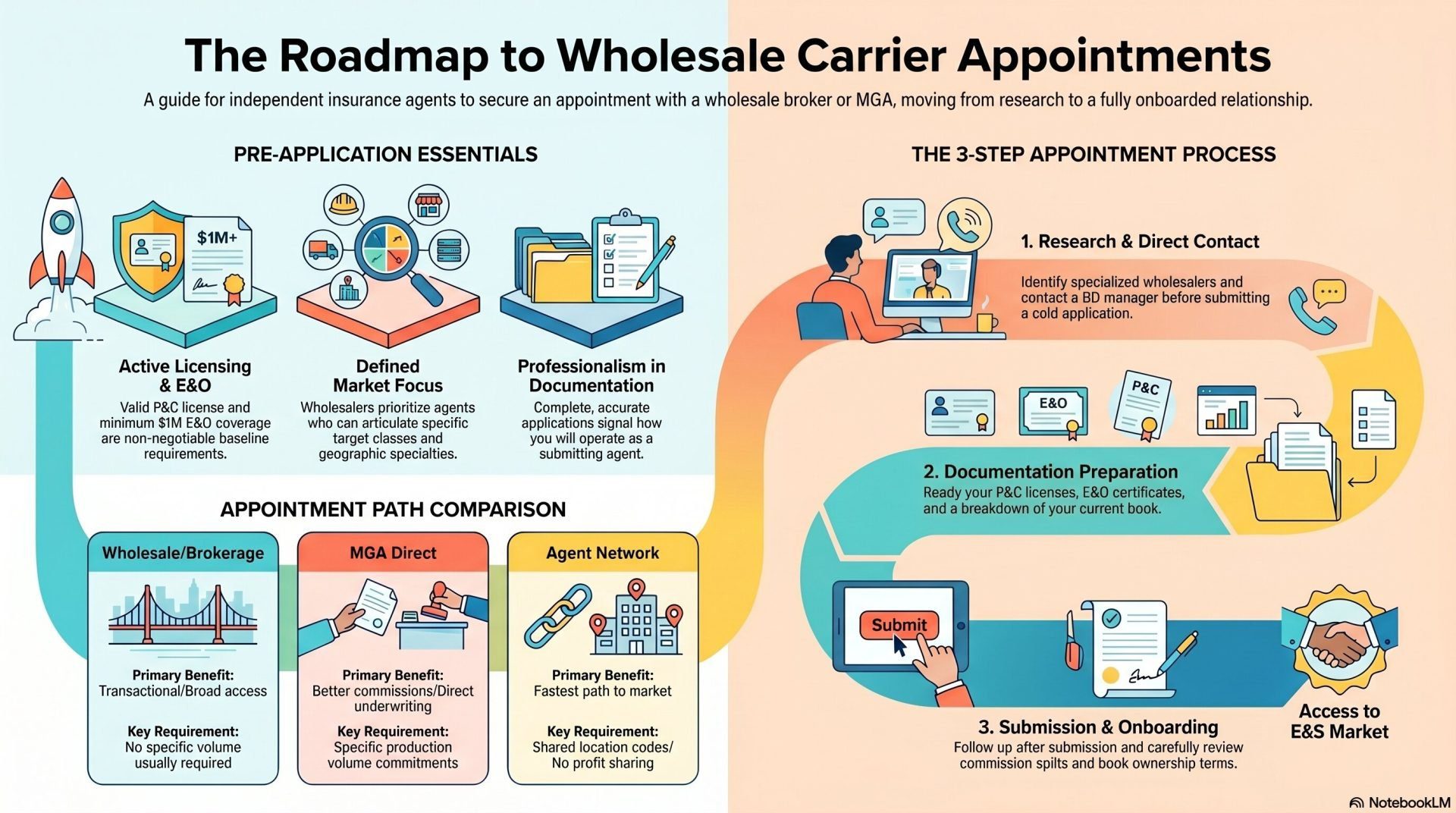
Wholesale/Brokerage Appointments place you in a transactional relationship with the wholesaler. You submit a risk, they work it, and you earn a commission on what binds. You typically retain ownership of the business and are listed as the Agent of Record. Transfers can sometimes be complicated, so clarify upfront.
MGA Direct Appointments give you a more direct relationship with a managing general agent that has underwriting authority for specific carriers. These often come with better commission rates, faster quote turnarounds, and direct underwriter access, but they usually require production volume commitments to earn and maintain.
Producer Appointments through Networks allow you to access wholesale markets through an independent agent network or aggregator. You typically don’t have a location-specific code and may not qualify for profit sharing, but it’s a faster path to market access when you’re building volume.
What Wholesalers Are Actually Looking For
Before you submit an appointment application, understand what the wholesaler is evaluating. This isn’t a checkbox process. Wholesalers are deciding whether working with you is a productive use of their time and resources.
Active Licensing
The baseline requirement is a valid property and casualty license in the state where you intend to do business. Most wholesalers also require active E&O coverage, typically at a minimum of $1 million per occurrence. Some will ask for proof of your agency’s E&O certificate before they process your appointment. Have it ready.
A Defined Book and Market Focus
Wholesalers work most effectively with agents who have a clear sense of what they write and where they’re headed. This doesn’t mean you need a thick business plan document, but you should be able to articulate your target classes, your geographic focus, and the types of risks you expect to bring them. Generalists who submit one random risk at a time across twelve different lines are harder to build a productive relationship with than agents who consistently bring a specific class of business.
Production Volume or a Credible Growth Plan
Larger national wholesalers often have minimum volume thresholds, either in annual premium or number of submissions, before they’ll invest in a formal appointment. This is more common with direct MGA appointments than with general wholesale brokerage relationships. Smaller regional wholesalers tend to be more flexible, particularly for agents who are newer to E&S but show a clear intent to grow that part of their business.
If you’re early in building E&S volume, be transparent about it. Position yourself around your growth trajectory and the specific classes you’re focusing on, rather than trying to look bigger than you are. Wholesalers respect honesty more than inflated projections.
Professionalism in the Application Process
How you show up in the application process signals how you’ll operate as a submitting agent. Incomplete applications, missing documentation, or vague answers about your book are red flags. Treat the appointment application the way you’d want a client to treat a coverage application: complete, accurate, and professionally prepared.
Join the Agency Height Newsletter.
Stay ahead with industry trends, acquisition opportunities, and growth insights for ambitious insurance professionals.
The Step-by-Step Appointment Process
Step 1: Identify the Right Wholesalers for Your Classes
Not all wholesalers are built the same. A firm with deep appetite in coastal property may have thin capacity in professional liability. A specialty MGA writing contractors may have no appetite for hospitality risks.
Start by mapping your current book and your intended E&S business to the wholesalers who specialize in those classes. Industry resources like MyNewMarkets.com allow you to search by coverage class and state. WSIA (Wholesale and Specialty Insurance Association) membership directories are another strong reference. Ask other agents in your network who they use for specific classes, and pay attention to which wholesalers show up consistently in those conversations.
For scale, the national shops like Burns & Wilcox, AmWINS, Ryan Specialty, and CRC Group cover broad lines and geographies and are reasonable starting points. Regional wholesalers often run faster and go deeper in specific niches. Build relationships across both.
Step 2: Make Direct Contact Before You Apply
The most common mistake agents make is submitting an appointment application without any prior contact. Cold applications to large wholesalers often get deprioritized or overlooked entirely.
A better approach: identify the right person to contact, usually a business development manager or a producer, and have a brief conversation before you submit anything formal. Introduce your agency, describe the classes you write, and ask about their appetite and appointment process. Industry events, carrier conferences, and continuing education settings are natural places to connect with wholesaler reps. LinkedIn is underused in this context but effective if your outreach is specific and not generic.
A warm application, where the underwriter or BD contact already knows your name and what you write, moves faster and receives more attention than a cold form submission.
Step 3: Gather Your Documentation
Most wholesale appointment applications require a consistent set of documents. Have these ready before you start:
Active P&C license certificate for each relevant state. E&O insurance certificate showing carrier, policy number, effective dates, and coverage limits. Agency information including legal name, principal address, years in operation, and ownership structure. A brief description of your current book of business broken down by line, premium volume, and primary states. Any carrier appointments you currently hold in the admitted market. References from carriers or other wholesale partners if you have them.
Some applications also ask for your agency management system, your technology setup, and whether you have binding authority experience. Answer these accurately. Wholesalers use this information to understand how sophisticated your operation is and how smoothly submissions will move through their workflow.
Step 4: Submit and Follow Up
Appointment timelines vary. Smaller regional wholesalers can process appointments in days. Larger nationals may take several weeks, particularly if your application goes through multiple review layers.
Follow up respectfully if you don’t hear back within the stated timeline. Wholesaler appointment teams are busy, and a well-timed follow-up that reiterates your intent and the classes you bring rarely hurts. Persistence without being pushy is the right calibration here.
Step 5: Onboard Properly
Once the appointment is approved, take the onboarding process seriously. Review the commission agreement carefully, paying particular attention to how commissions are split, what fees the wholesaler charges, and under what conditions those fees apply.
Some wholesalers add administrative fees, policy fees, or surplus lines filing fees on top of their commission split. These aren’t always disclosed upfront. Ask directly: what is the gross commission on a typical placement, what does the wholesaler retain, and what do you net? Knowing the full economics before you bind your first risk protects you from surprises and helps you price correctly for your clients.
Also clarify who owns the book of business if the relationship ends. This matters more than most agents realize when they’re starting out.
Building the Relationship After You're Appointed
Getting appointed is the starting line, not the finish. The value of a wholesale relationship compounds over time, and the agents who build the strongest wholesale partnerships are the ones who treat it like a two-way relationship rather than a transactional one.
Send quality submissions. A well-prepared submission with complete risk information, loss runs, and a clear narrative on the account moves faster and gets better market attention than a thin application with missing data. Underwriters have limited time, and agents who make their job easier earn faster turnarounds and more market access over time.
Communicate consistently. If a client you submitted is going to bind elsewhere or the risk has changed, tell your wholesaler. Don’t go dark. Transparency in the submission process builds trust, and trust translates into underwriters going the extra mile on difficult risks.
Bring volume in a focused class. A wholesaler who sees you consistently submitting in a specific niche, say contractors or coastal property, will start routing new appetite and programs your way. Specialization signals to your wholesale partners that you know your market, and it builds your reputation as a credible source of business in that class.
Common Reasons Agents Get Passed Over
Knowing what disqualifies an appointment application is as useful as knowing what earns one.
Incomplete or inaccurate applications. Missing E&O certificates, vague descriptions of your book, or inconsistencies between your stated production and your actual carrier appointments raise questions before the relationship even starts.
No defined focus. An agent who writes a little bit of everything with no apparent specialization is harder to route business through. Wholesalers build appetite around specific classes. If you can’t articulate yours clearly, the application stalls.
E&O gaps or coverage below minimums. Non-negotiable for most wholesalers. If your E&O coverage is below their threshold or has lapsed, the application doesn’t move until that’s resolved.
Unrealistic volume expectations. Applying to a national MGA for a direct appointment with $50,000 in projected E&S premium is a mismatch. Know where you sit in terms of production and approach wholesalers whose minimum thresholds you can realistically meet or credibly grow toward.
A Note on Managing Multiple Wholesale Relationships
Once you’re appointed with one wholesaler, don’t stop there. The agents who operate most effectively in the E&S market work with multiple wholesale partners simultaneously, routing specific classes to the wholesalers with the deepest appetite in those areas.
The goal is not to have twenty wholesale relationships you barely use. It’s to have four or five strong ones across complementary specialties, where each wholesaler sees you as a productive, focused source of business in their lanes. That combination gives you broader market access, competitive tension when you’re shopping a risk, and backup capacity when one market pulls back on a class.
The Bottom Line
Getting appointed with a wholesale carrier is not complicated, but it does reward preparation. Know your book, know which classes you’re bringing, and know which wholesalers have the deepest appetite in those lines before you submit anything.
The relationship you build with your wholesale partners will determine the quality of markets you can access, the speed at which you can quote and bind, and ultimately the breadth of business you can write. Treat it accordingly from day one.
If you missed the earlier pieces in this series, start with [How to Access E&S Carriers as an Independent Agent] for the foundational overview of the E&S market and your access pathways, then return here for the appointment mechanics.
Agency Height helps independent agents build stronger, more diversified books of business. Explore our agent resources, market guides, and tools on the Agency Height platform.
Frequently Asked Questions
-
How long does a wholesale appointment take?
Regional wholesalers can move in days. Larger national shops may take two to four weeks, especially if your application goes through multiple review layers. Following up respectfully speeds the process.
-
Do I need an E&O policy to get appointed?
Yes. Most wholesalers require active E&O coverage, typically $1 million per occurrence minimum, before they’ll process an appointment. Have your certificate ready before you apply.
-
What if I don't have much E&S volume yet?
Start with regional wholesalers and smaller MGAs, who are more flexible on volume minimums. Be transparent about where you are and where you’re headed. A credible growth plan carries more weight than inflated projections.
-
Can I be appointed with more than one wholesaler?
Yes, and you should be. Most active E&S agents work with multiple wholesalers simultaneously, routing specific classes to the shops with the deepest appetite in those areas.
Free Carrier Access. $0 to Start.
Carrier Said No? There's Still a Market.
Table of Contents
- What a Wholesale Appointment Actually Is
- What Wholesalers Are Actually Looking For
- The Step-by-Step Appointment Process
- Building the Relationship After You're Appointed
- Common Reasons Agents Get Passed Over
- A Note on Managing Multiple Wholesale Relationships
- The Bottom Line
- Frequently Asked Questions
- What a Wholesale Appointment Actually Is
- What Wholesalers Are Actually Looking For
- The Step-by-Step Appointment Process
- Building the Relationship After You're Appointed
- Common Reasons Agents Get Passed Over
- A Note on Managing Multiple Wholesale Relationships
- The Bottom Line
- Frequently Asked Questions
More Markets. More Leads. One Platform.
Sign up now for carrier access, get found online, and write more business.
Your email has been registered. Redirecting...